From June 1988 through June 1993, Lee and Amanda rent an upper maisonette at 22D Carrowby Terrace, Pimlico, London SW1. They’re located very close to the Pimlico/Westminster border and can walk to London Victoria Station.
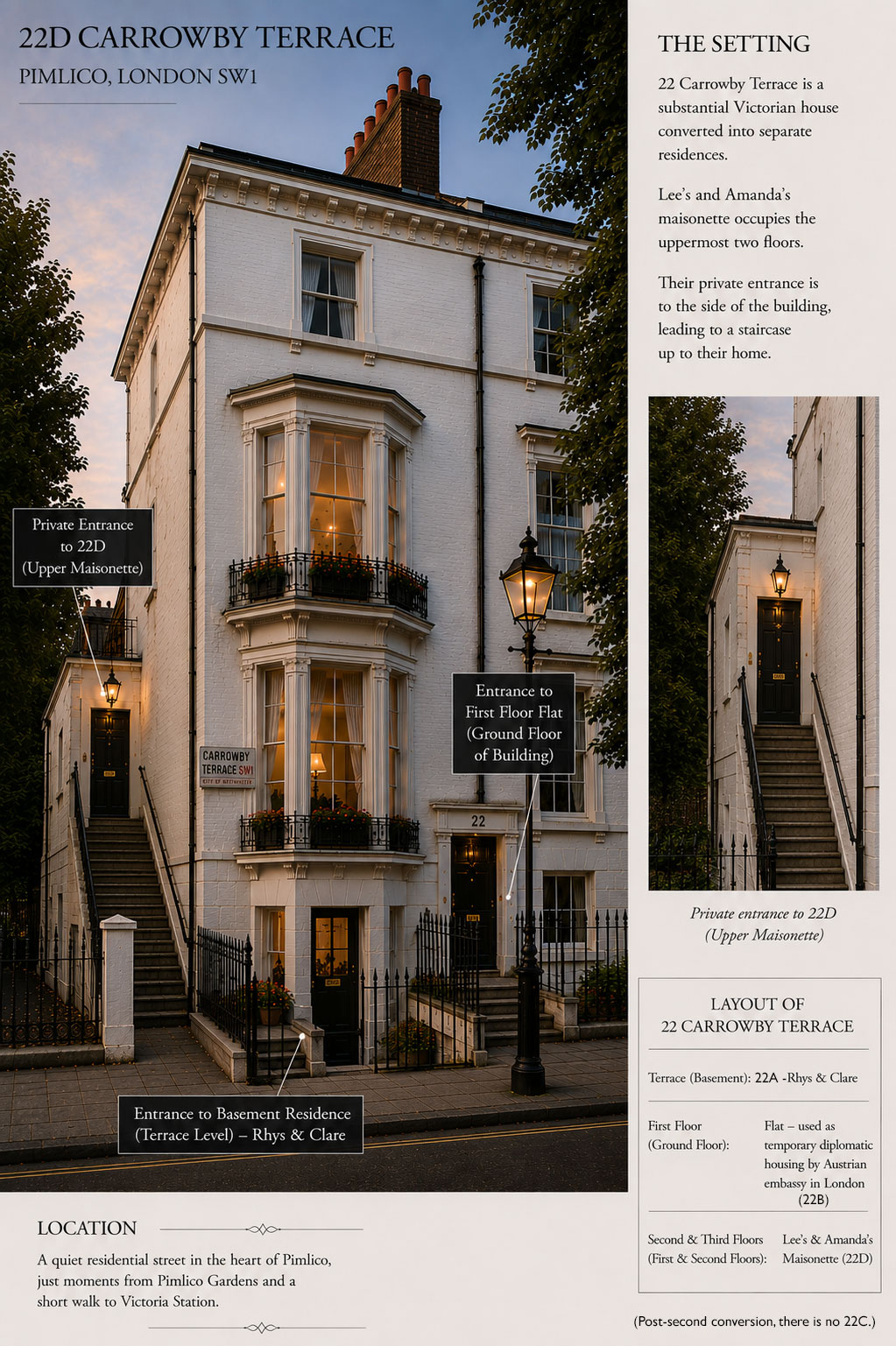
Exterior of 22 Carrowby Terrace (click to enlarge)
22 Carrowby Terrace is a substantial Victorian townhouse converted into separate residences during the 1960s. At the time of its first conversion, it was separated into four flats (22A through 22D), one per floor. During the early to mid-1980s, the owner of 22D purchased 22C and remodeled the two flats into a combined, two-floor unit. Since the owner’s original address was 22D, that became the surviving address for the combined unit.
The two remodels mean that their maisonette has what’s commonly referred to as “character.” However, it’s in very good condition and the location is extremely desirable. As such, their initial monthly rent was £1,050 per month. This felt unbelievably high to Amanda, but the figure fell comfortably within their household budget thanks to their combined salaries.
The terrace-level (basement) unit was a flat occupied by a young married couple, Rhys and Clare Davenport. The Austrian Embassy owned the ground floor (first floor) flat and used it as temporary housing for visiting diplomatic staff. As such, the building was generally kept somewhat more secure than normal, which Lee and Amanda found attractive.
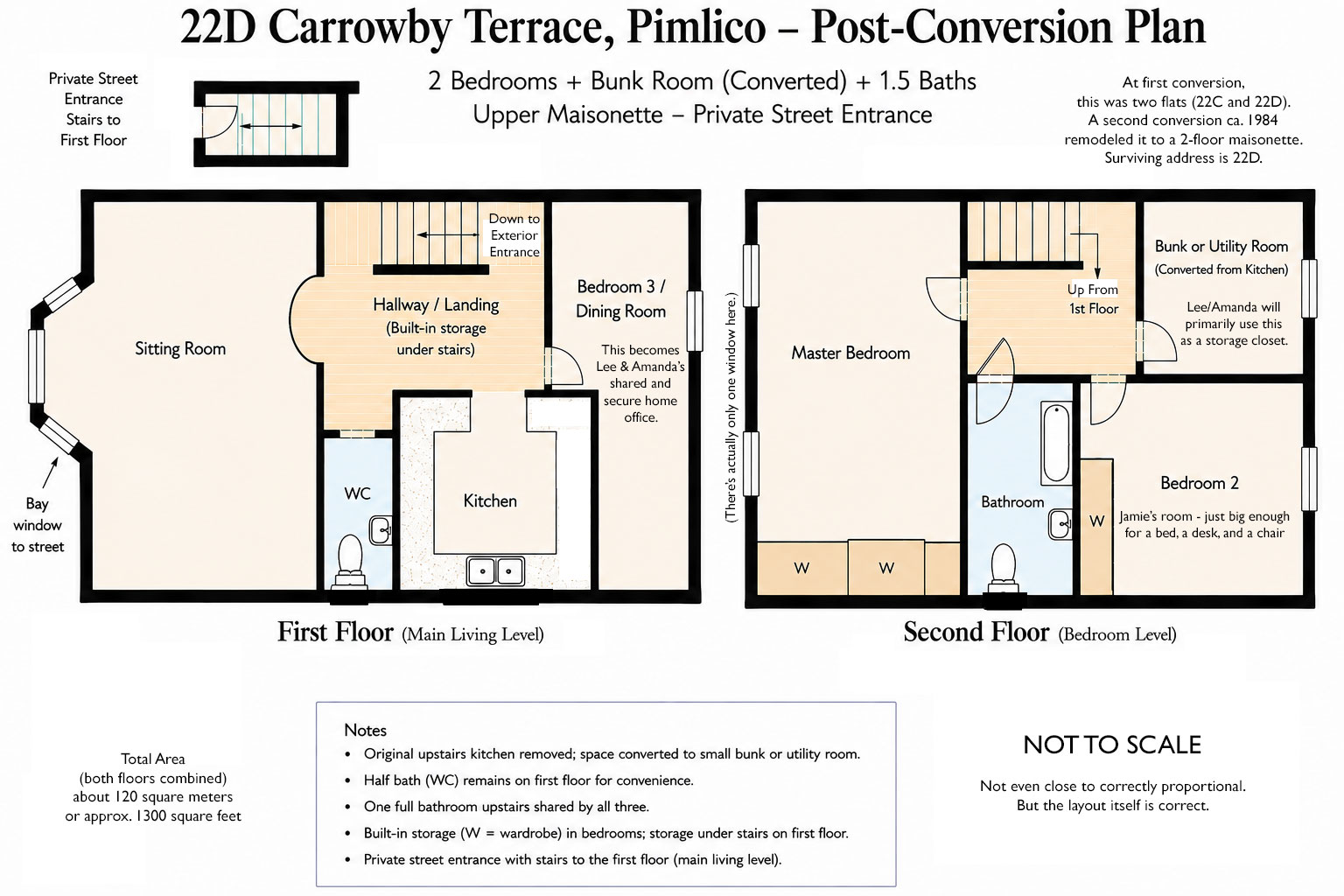
22D Carrowby Terrace floor plan
(click to enlarge)
While both the initial conversion and the subsequent remodel were carried out with some thought, the nature of the unit meant that the floor plan was still somewhat awkward in places. The first floor contained a living/sitting room, an efficiency-style kitchen, a water closet and a room that was initially presented as a dining room or third bedroom.
The second floor had two bedrooms, both with built-in wardrobes, and a third room that was presented as a bunk room or utility/auxiliary room (it had no built-in wardrobe). It had originally been the upper level’s own efficiency-style kitchen. This floor also contained a full bath. Lee and Amanda used the larger bedroom while Jamie used the smaller one.
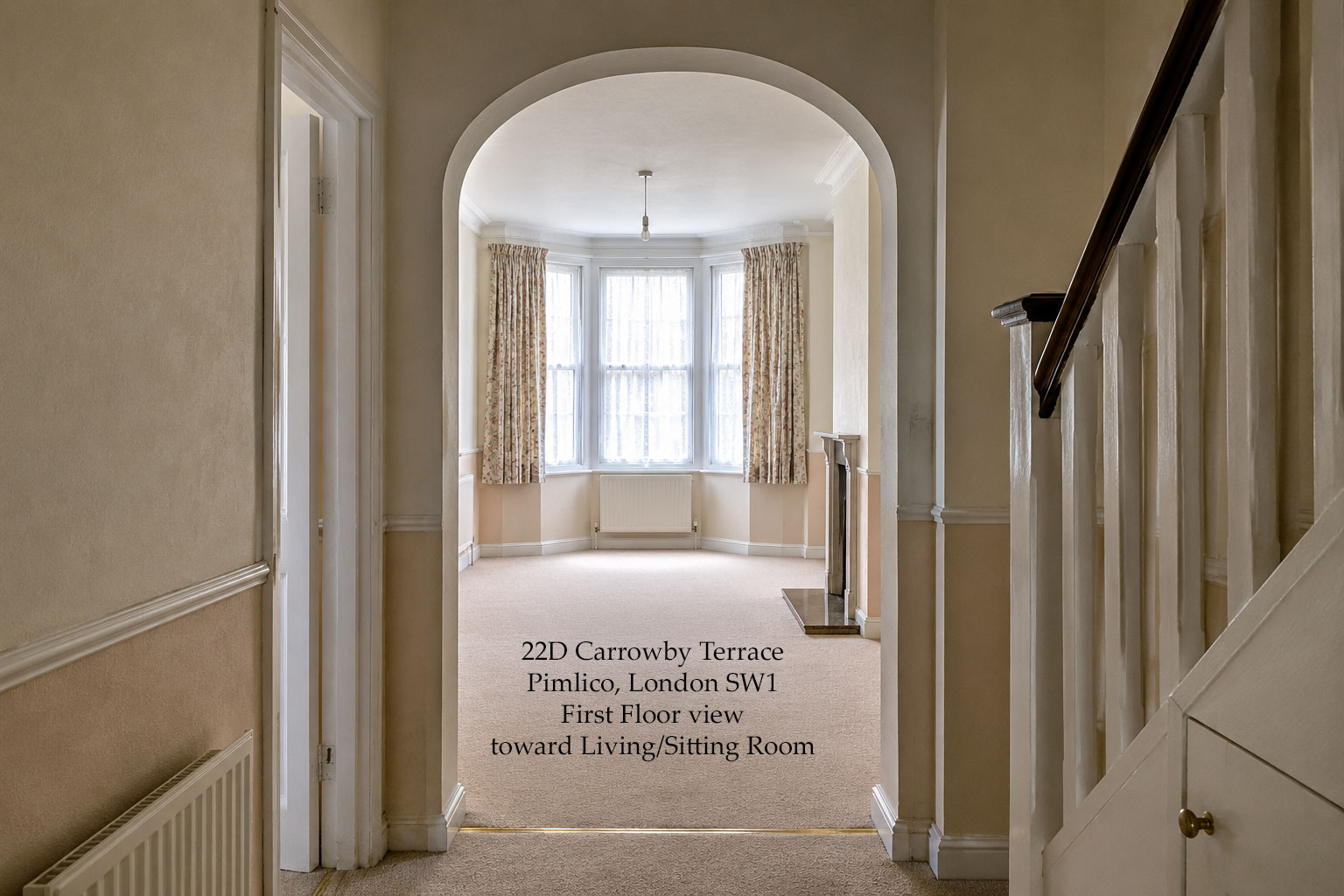
22D Carrowby Terrace interior — first floor (click to enlarge)
The interior styling was solid, but gloriously generic in that way only a converted Victorian row house can be. While Amanda initially despaired at being able to make it as homey and welcoming as she liked, their landlord allowed them considerable latitude in décor. It never could be — and never was — particularly spacious, but with time and effort it became warm and cozy.
Since the dedicated dining room area was not particularly well-placed for that usage, and since the upstairs spare room was too small, Lee and Amanda elected to use the dining room as their combined shared (and secured) office. This required them to carve out a corner of the sitting/living room for dining. They chose to use a smaller table than the ones they’d used before; it seated three comfortably enough, but was full at four and crowded at five.
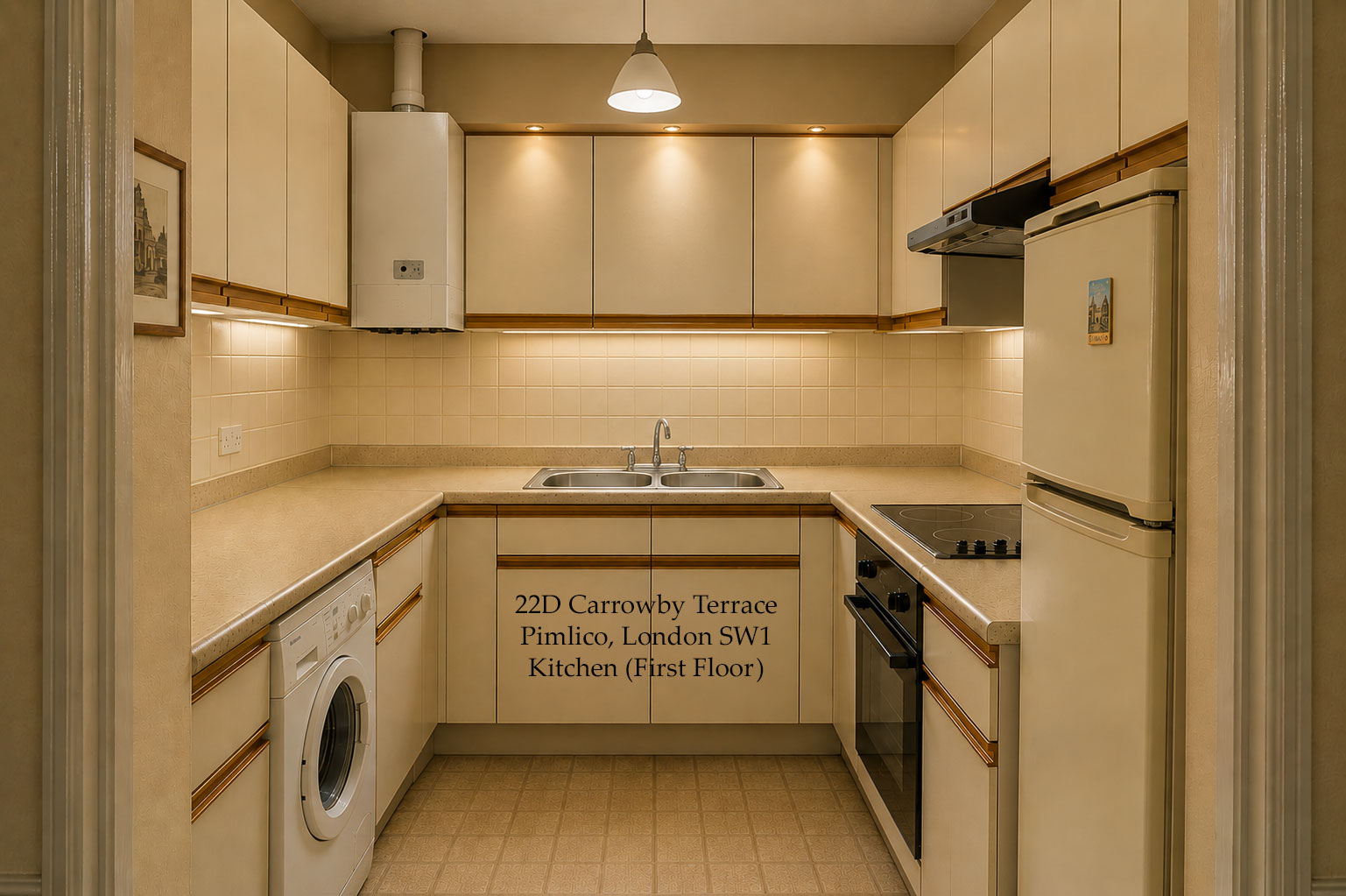
22D Carrowby Terrace interior — kitchen (click to enlarge)
Amanda had not seen or been asked to use such a small kitchen since she’d been in college, and ordinarily would not have been willing to accept such a small kitchen in her full-time residence. However, by the time she and Lee viewed 22D Carrowby, she had already seen several other London kitchens and realized that this one was well-equipped and well laid out. It contained an electric cooking hob, an electric oven, a ventless washer-dryer combo, a refrigerator/freezer and the boiler (hot water heater).
Due to being situated on an interior wall, it had no windows. However, strategic décor choices and use of a lot of light made it pleasant as well as functional. It was always, however, strictly a one-person kitchen.
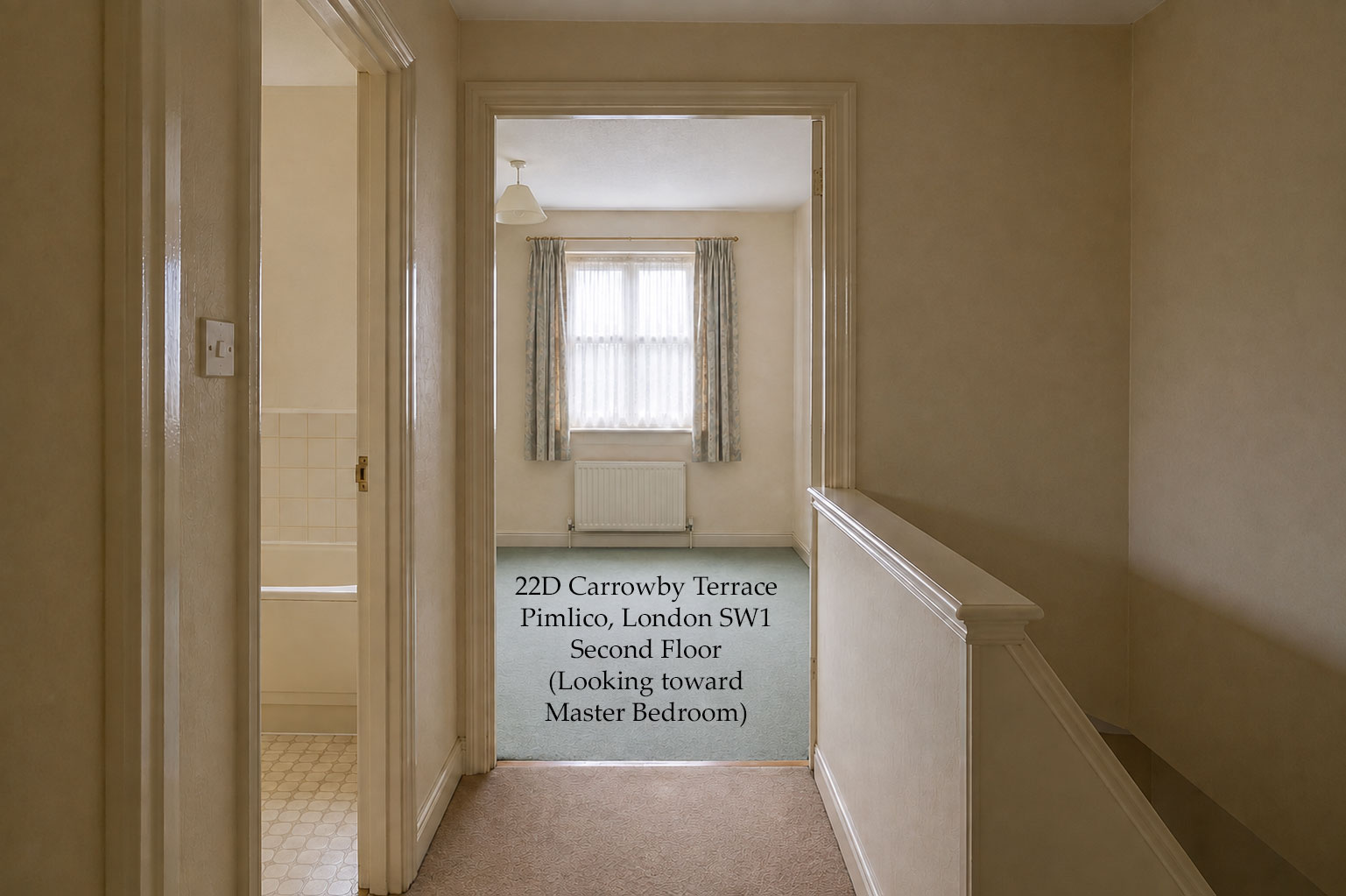
22D Carrowby Terrace interior – second floor (click to enlarge)
Because this maisonette was on the upper floors of the building, the rooms that did have windows got good light; and again, since the conversion and remodel were done thoughtfully, rooms without windows had sufficient lighting fixtures available. Floor and wall surfaces were definitely 1980s-style in nature, but in good condition.
The home was heated by wall radiators. Like most homes in London, there was no air conditioning — but given London’s usual weather, the strategic use of windows (which were situated to allow for cross-breezes) and fans was sufficient for all but the very hottest of days.
22D Carrowby Terrace wasn’t the most luxurious of homes, but it was a well-located, well-maintained, solidly built and functional example of London city architecture for its time. After Lee and Amanda vacated it to move back home to the United States, they always remembered it with a smile. That smile might occasionally have been sardonic, but it was never unwarranted.
Notes:
- While Pimlico, Westminster, and Victoria Station are real, Carrowby Terrace is fictional. The street geography in the Restless Hearts series is deliberately left a bit unclear to account for this. Descriptions of their neighborhood and local surroundings are based on pictures and maps of the general area.
- Images and floor plan were generated by ChatGPT and are meant to be representative, but may contain minor architectural, formatting, or proportional errors.